Renowned Microbiologist visits Institute of Subtropical Agriculture, CAS
Professor Matthias Hess, a Hellman Fellow and renowned microbiologist from the University of California, Davis, visited the Institute of Subtropical Ecology Agriculture from November 10 to 15, 2025. He was invited by Professor Tan Zhiliang, Secretary of the Party Committee of the Institute of Subtropical Agriculture and Ecology, Chinese Academy of Sciences, for collaborative research and academic exchange.
Matthias Hess is currently affiliated with the Department of Animal Science, College of Agricultural and Environmental Sciences, University of California, Davis. He has long been engaged in research on ruminant micro-ecosystems and their environmental impacts. His research areas include Animal Health/Animal Microbiology, Climate Change/Carbon and Nitrogen Cycling, Natural Products.
On Nov 12th, Matthias Hess delivered an academic report titled “Metatranscriptomics of the Rumen Microbiome Reveals Alternative Pathway for Rumen Hydrogen Under Suppression of Methanogenesis.” In his report, he detailed his team’s research progress on the microbial mechanisms by which the addition of red algae and other local California agricultural byproducts to the diet regulates methane emissions from the gastrointestinal tract of ruminants, the regulation of rumen microbial gene expression, and the pathways of rumen microbial hydrogen metabolism. On the 14th, he participated in the “Xiangzhi Xingxiang Science and Technology Talent Salon—Youth Talent Special Session on Agricultural Ecology and Rural Revitalization” held at the Institute of Subtropical Agriculture and Ecology, where he presented a report titled “Learning from Microbes to Improve Agriculture & the Environment”. In his presentation, he systematically elaborated on the role of microorganisms in global hot topics such as the transition to ecological agriculture and regional ecological restoration, covering aspects such as natural microbial communities and their functions, microbial genomics, precise microbial gene editing technologies, microbial functional division of labor and efficient decomposition strategies, and the identification of carbohydrate-active enzymes.
This collaborative exchange deepened the cooperation between the two parties in the field of ruminant microbiology research and laid an important foundation for future collaboration.
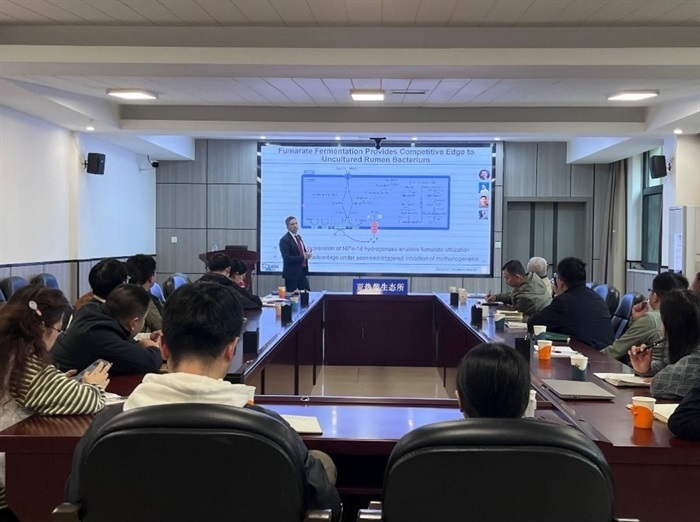
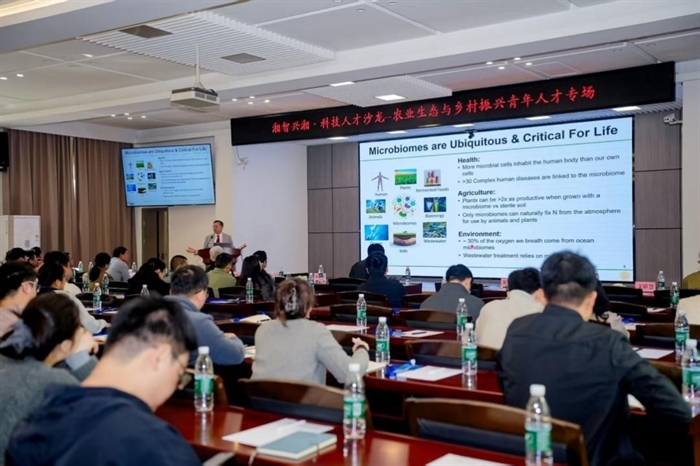
Meeting Venue
Download attachments:

 中文
中文


