New Insights into How Multitrophic Organisms Adapt to Phosphorus Limitation in Subtropical Ecosystems
A research team led by Prof. Kelin Wang from the Institute of Subtropical Agriculture, Chinese Academy of Sciences, has made significant progress in understanding how multitrophic organisms adapt to phosphorus (P) limitation in subtropical ecosystems. Their findings, published online in Journal of Advanced Research, shed light on mechanisms to alleviate P limitation in fragile subtropical ecosystems.
P limitation severely constrains agricultural sustainability and the stability of forest ecosystem structure and function in subtropical regions. While plants and phosphate-mobilizing bacteria are key drivers of soil P mobilization, their effectiveness is influenced by climate, land use, lithology, and higher trophic levels. Previous research focused on single abiotic or biotic factors, leaving a gap in understanding how multitrophic organisms adapt to P limitation under varying lithological conditions.
The team established a north-south transect in subtropical Southwest China across contrasting lithologies – carbonate (karst) rocks versus clastic (non-karst) rocks. They investigated how multitrophic biodiversity and interactions influence soil P mobilization during the transition from cropland to forest succession. They found that long-term fertilization in both karst and non-karst croplands increased the accumulation of moderately labile and stable P pools while weakening biological P mobilization capacity. After the conversion of cropland to forest, the labile P fraction in karst soils increased by 43.8%, while the moderately labile P and stable P fractions decreased by 79.1% and 36.6%, respectively. In non-karst soils, the moderately labile P and stable P fractions decreased by 62.6% and 34.8%, respectively. Multitrophic biodiversity and P activation capacity were significantly higher in karst regions than in non-karst regions. Forest restoration in the karst regions enhanced the cascade interactions among phosphate-mobilizing bacteria, mycorrhizal plants, and nematodes. This synergy enhanced biological P mobilization and uptake, which reduced P precipitation by calcium/magnesium and consequently alleviated P limitation. This study highlights the vulnerability of karst ecosystems, where human disturbances like tillage and deforestation readily cause species loss and disrupt critical multitrophic interdependencies.
"We highlight the critical roles of reducing mineral P inputs and enhancing legacy P mobilization through biological pathways to promote agricultural sustainability and support the recovery of degraded ecosystems under global change," said Prof. Jie Zhao, corresponding author.
Contact: Jie Zhao
E-mail: jzhao@isa.ac.cn
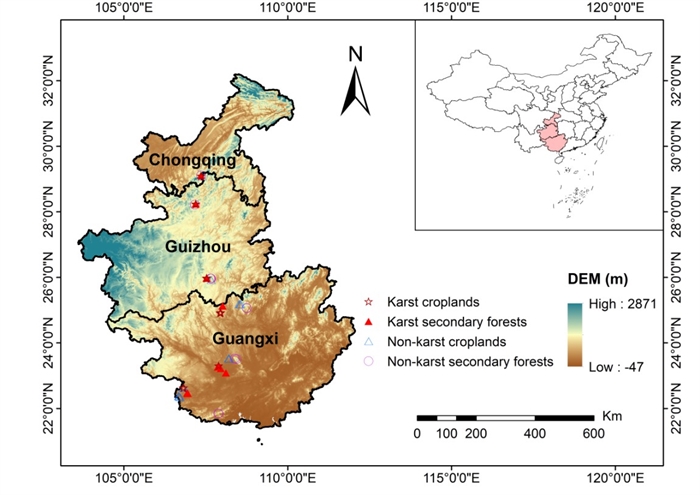
Sampling sites in the karst and non-karst regions of southwest China. (Image by Xionghui Liao)
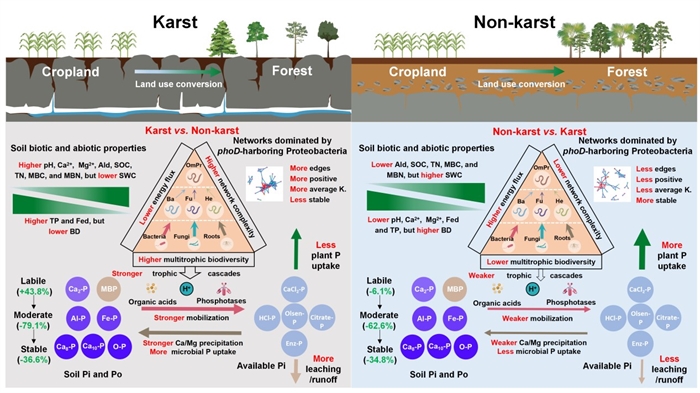
Conceptual diagram illustrating how multitrophic organisms adapt to P limitation under different lithological conditions. (Image by Xionghui Liao)
Download attachments:

 中文
中文


