

Research Progress
Microbial Metabolism and Life Strategies Reveal the Functional Mechanism of Soil Carbon Cycling
A research team led by Prof. WANG Kelin from the Institute of Subtropical Agriculture of the Chinese Academy of Sciences conducted a regional-scale sampling in a karst region in southern China.
Due to their incredibly diverse and sophisticated metabolism abilities, soil microbes represent the largest share of Earth's biodiversity and are involved in nearly every process that occurs in soil. Storing carbon in soil is key to enhancing many of its essential ecological functions and services. However, agricultural activities can seriously disrupt the work of soil microbes—and in turn, weaken the soil's ability to capture and hold carbon. Prof. WANG Kelin told us their purpose is to understand how the life strategies of microbes are linked to soil carbon cycling for managing carbon in agroecosystems.
Recently, their findings, published in Soil & Tillage Research, revealed how microbes adapt to different environments in agricultural soils and how this microbial adaptation strategy affects soil carbon cycling.
The team investigated four typical farmland systems under varying intensities of agricultural disturbance—pasture, sugarcane farmland, rice paddy fields, and maize cropland—all located on the region's predominant calcareous and red soils.
According to the researchers, calcareous soil is a "bacterial paradise" with higher abundance and diversity, while acidic red soil functions as a "fungal fortress" better adapted to harsher conditions. In fertile calcareous soil, microbes prioritize growth and build biomass, aiding carbon storage. In stressful red soil, they spend energy on survival and stress tolerance, which is less efficient for locking away carbon. Farming intensity can disrupt this natural system. The beneficial carbon-storing link is clear in low-disturbance lands like pastures, but high-intensity agriculture (e.g., frequent tilling in maize/rice fields) can weaken this microbial-driven process.
"Our research reveals how soil types and agricultural practices determine microbial survival strategies, which in turn control carbon storage, offering a clear path to protect and enhance this natural process through smarter farming." said Prof. ZHAO Jie, the corresponding author of the study.
Contact: Jie Zhao
E-mail: jzhao@isa.ac.cn
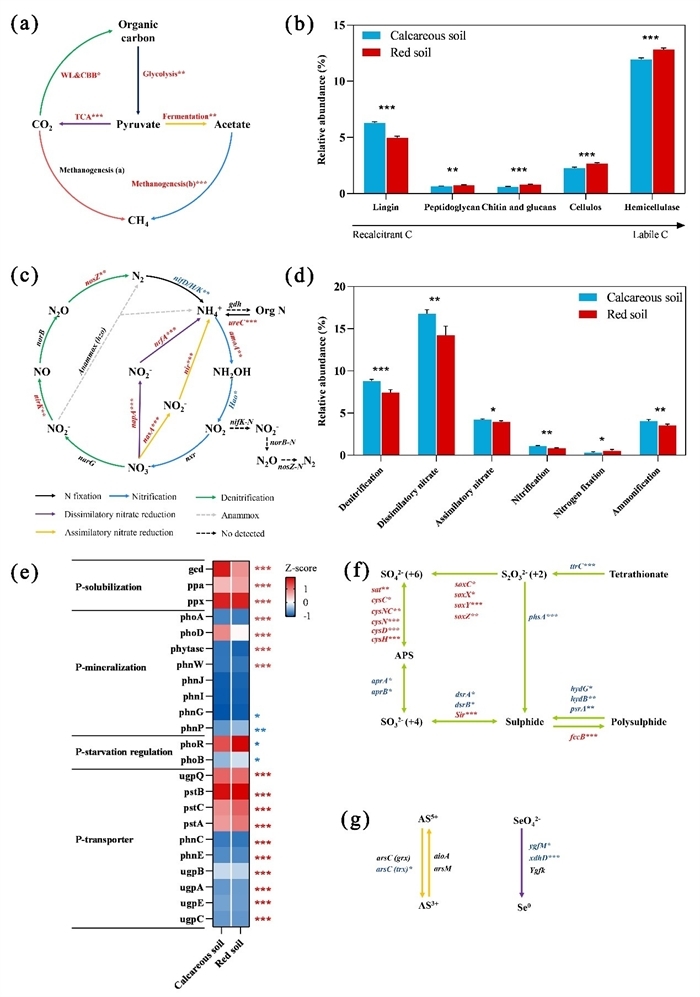
Functional potentials of microbiomes in calcareous soil and red soil (Image by LONG Xianwen)
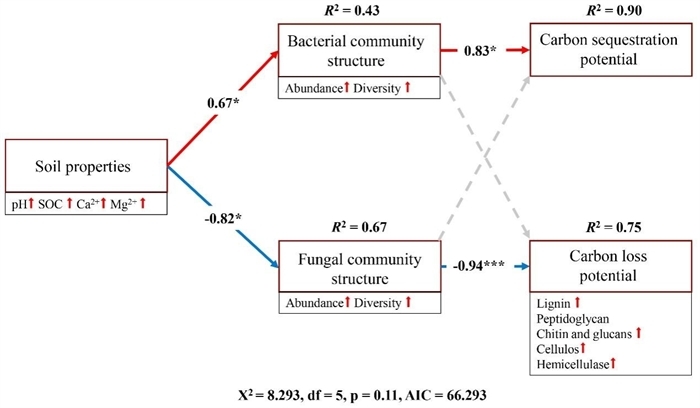
Microbial driving mechanisms of soil carbon sequestration and decomposition potential (Image by LONG Xianwen)
