

Research Progress
Soil-Rock Structure Controls on Plant Water Adaptation Strategies in Karst Regions, Study Find
As global vegetation greening continues to accelerate, ensuring the long-term sustainability and stability of ecosystems has become a central challenge in terrestrial ecosystem research., Karst region in Southwest China, one of the most actively recovering vegetation zones in the world, and also a complex soil-rock structure, where plant survival and growth are shaped not only by climate but also profoundly by the underlying soil-rock structure. However, the mechanisms by how rock-soil structures mediate species coexistence and water use strategy differentiation remained unclear. This knowledge gap has limited the assessment of plant water adaptation strategies in complex habitats.
To address these questions, a research team led by Prof. CHEN Hongsong from the Institute of Subtropical Agriculture, Chinese Academy of Sciences, conducted field experiments in typical karstic peak-cluster depression small catchments in southwest China. They used electrical resistivity tomography, stable isotope analysis, and root functional trait measurements for typical shrub and herb communities in a dolomite shrub-grassland slop to explore how soil-rock structures drive the differentiation of plant water-use strategies and enable species coexistence.
Their latest findings were published in Plant and Soil (2026, 519: 291-237) and Tree Physiology (2026, 46(3): tpag013).
The results showed that dolomite landscapes have thin soils and limited fracture development, leading to shallow root systems concentrated in the 0–20 cm depth range. Nevertheless, different plant species exhibited distinct root morphologies, enabling coexistence through differential root spatial distribution and water use. Specifically, shrubs such as Vitex negundo and Tirpitzia ovoidea developed extensive lateral roots that penetrate shallow soil, soil-rock interfaces, and bedrock fractures.
In contrast, herbs like Neyraudia reynaudiana and Dicranopteris linearis had limited lateral root expansion, with most roots concentrated in the surface soil layer. The mean residence time of root-zone water used for plant transpiration (transpiration water age) ranged from 2 to 63 days. Root branching frequency showed a significant positive correlation with mean transpiration water age, indicating that higher branching frequency facilitates fine roots accessing niche spaces with different water ages. These findings reveal that in highly heterogeneous, lithology-controlled habitats, plants coexist through spatiotemporal differentiation of hydrological niches.
Furthmore, they systematically analyzed root water uptake sources, xylem hydraulic traits, and leaf carbon-oxygen acquisition capabilities of five typical restored tree species common to both limestone and dolomite habitats. The results showed that limestone plants adopt an “acquisitive” strategy, accessing deep and stable water sources, and can trade off hydraulic safety for higher hydraulic efficiency and leaf carbon-oxygen acquisition capacity. In contrast, dolomite plants adopt a “conservative” strategy: their roots are restricted to shallow, fluctuating water sources, but they develop stronger hydraulic safety and lower carbon-oxygen acquisition capacity to reduce the risk of hydraulic imbalance.
The study reveals a systematic trade-off along the root–xylem–leaf continuum in plant water-use traits. Stronger dependence on shallow water is associated with greater hydraulic safety and higher water-use efficiency, but at the cost of slower growth. Greater access to deep water enhances hydraulic efficiency and allows more relaxed stomatal regulation, but reduces resistance to drought risk. This coordination and trade-off between belowground and aboveground functional traits underpins the physiological and ecological adaptation of karst tree species to different bedrock environments.
In summary, these studies highlight the central role of geological structure in shaping vegetation water adaptation strategies and provide an important theoretical basis for vegetation restoration and management in karst regions.
Contact: CHEN Hongsong
E-mail: hbchs@isa.ac.cn
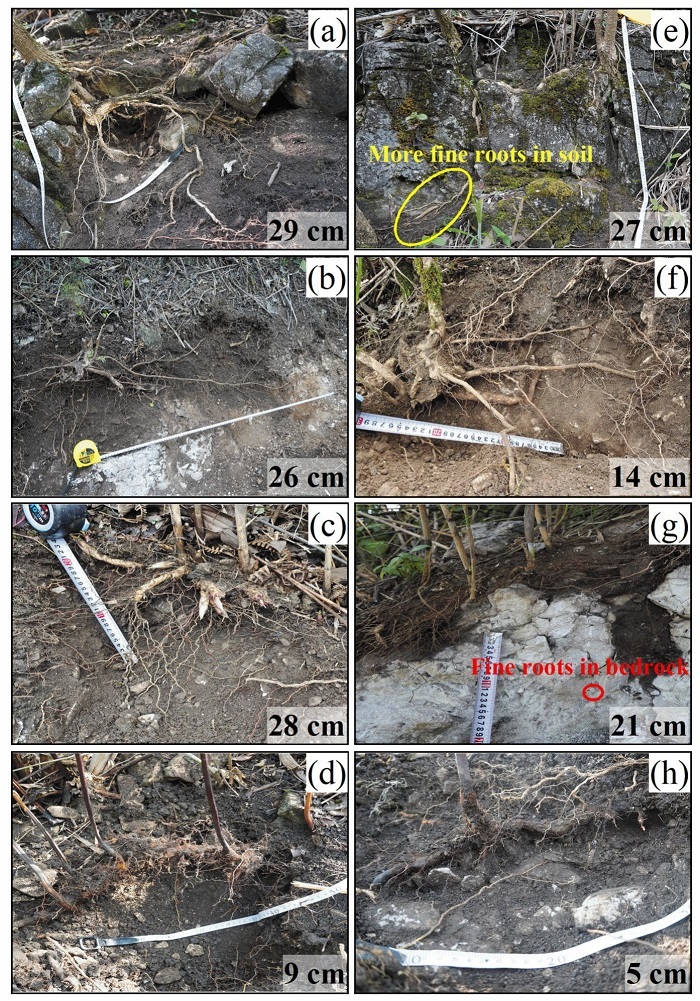
Figure 1 Root distribution patterns of four species (Imaged by LUO Zidong)
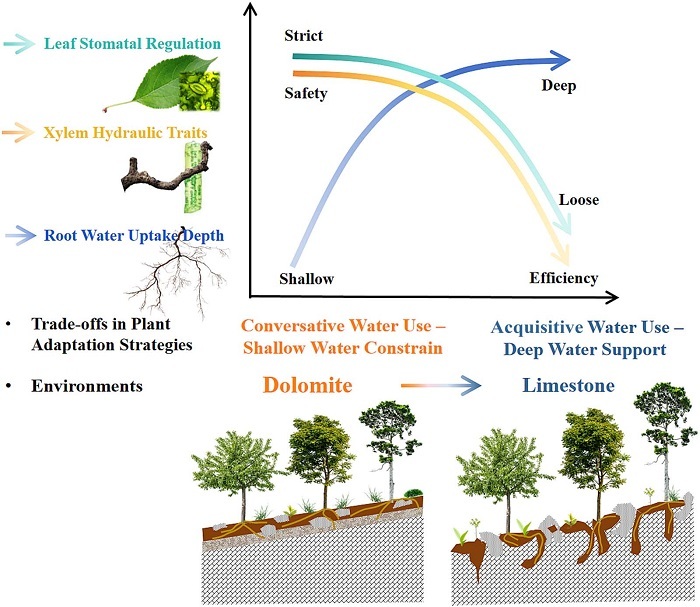
Figure 2 Conceptual model of plant water adaptation strategies in limestone versus dolomite habitats. (Imaged by LIU Wenna)
