

Research Progress
Scientists Uncover How Phosphorus Migration and Transformation in Wetland Systems
A reasearcher team led by Prof. Xie Yonghong from the Institute of Subtropical Agriculture Chinese Academy of Sciences, reveals the regulatory mechanism of aquatic vegetation types on the migration and transformation of pollutant phosphorus under gradient nutrient loadings.
These new research results were recently published in Ecological Indicators.
Aquatic macrophytes are widely used in ecological restoration because they intercept nutrients and stabilize sediments, the first author, Dr. Ma Xiaowen told that global management still lacks a clear mechanistic understanding of how plant life forms and their rhizosphere microbial communities jointly regulate phosphorus mobility at the sediment-water interface under varying nutrient loadings and across phenological stages.
Controlled macrophyte-water-sediment mesocosms representing three contrasting life forms were builted—submerged Vallisneria natans, rooted floating-leaf Nymphoides peltata, and emergent Typha angustifolia—and exposed them to gradient nutrient loadings. The results revealed life form-specific and phenology-dependent strategies: V. natans acted as a fast but time-variable regulator that strongly suppressed phosphorus release under high nutrient loading via rhizosphere processes and higher microbial diversity; N. peltata followed a conservative pathway, enhancing phosphorus retention within sediments but exerting limited control over sediment-water exchange; and T. angustifolia provided stable, long-term phosphorus sequestration through extensive belowground organs, supporting the most complex and resilient rhizosphere microbial network. Across all systems, microbial key taxa were tightly linked to phosphorus properties, indicating an active microbial role in shaping inorganic phosphorus solubilization, organic phosphorus mineralization, and Fe-bound phosphorus dynamics.
This work advances eutrophication management from “planting vegetation” to precision, mechanism-based restoration by showing that phosphorus control depends on the coordinated effects of plant life form, seasonal growth dynamics, and rhizosphere microbial feedbacks. “By identifying distinct functional roles, this study provides globally transferable principles for designing resilient wetlands under variable nutrient pressures.” Prof. Xie Yonghong emphasied “Equally important, it elevates rhizosphere microbial networks from a hidden component to a strategic target for restoration, highlighting key taxa linked to phosphorus transformations and system stability. These insights establish a foundation for internationally scalable, nature-based solutions, fostering more durable and predictable outcomes in aquatic ecosystem recovery”.
Contacted: Xie Yonghong
E-mail: xyh@isa.ac.cn
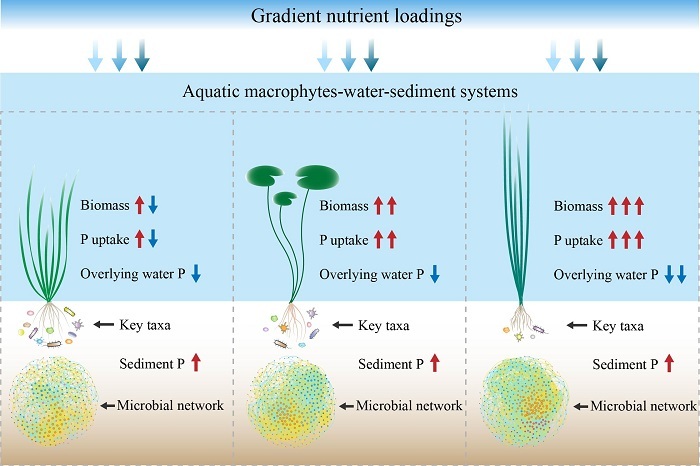
A schematic diagram illustrating the regulation of phosphorus migration and transformation by three types of aquatic plants (Imaged by Ma Xiaowen)
