

Research Progress
Scientists Identify Lithology as Key Driver of Forest Species Compositional variations Between Communities in Southwestern China
A research team led by Prof. Chen Hongsong from the Institute of Subtropical Agriculture, Chinese Academy of Sciences, has revealed that lithology-driven soil properties influence latitudinal variations of species composition in Southwestern China.
Beyond species richness, differences in species composition between communities provide critical insights into the mechanisms that maintain plant diversity. Traditionally, latitudinal variation in species composition has been largely attributed to climate gradients, particularly changess in temperature and precipitation that shape environmental conditions. However, growing evidence suggests that lithology, through its influence on soil environments, may also play an important role at broad spatial scales
Along a subtropical forest transect spanning approximately 10 degrees of latitude in southwestern China, a series of coordinated studies have been conducted to disentangle the roles of climate and geology in shaping plant diversity patterns. Previous work along this transect revealed pronounced differences in the latitudinal patterns of α diversity between karst and non-karst forests, with species richness in karst forests responding to latitude in a markedly different way from that in non-karst forests (Huang et al., 2025). Complementary studies of soil environments further demonstrated systematic contrasts in equivalent soil depth between karst and non-karst forests, with karst forests characterized by shallower and more spatially heterogeneous soils (Luo et al., 2024). In addition, investigations at the hillslope scale showed that shallow epikarst water plays a critical role in supporting the growth and persistence of plants inhabiting rocky karst habitats (Liu et al., 2024). Together, these cross-scale findings indicate that lithology, by reshaping soil environments, may exert a strong influence on regional biodiversity patterns beyond the effects of climate alone.
Building on this foundation, the present study focuses on latitudinal variation in species composition between forest communities. A total of 60 plots were established across six latitudinal sites along the transect, encompassing paired karst and non-karst forests. Species compositional dissimilarity was quantified using β diversity metrics, including total β diversity (βtotal), the species turnover component reflecting species replacement (βturnover), and the species nestedness component associated with species loss (βnestedness). Analyses were conducted separately for karst forests, non-karst forests, and the entire transect without distinguishing lithology, allowing a comparative assessment of the compositional variation under the two contrasting lithologies.
The results show pronounced differences in species composition between karst and non-karst forests. When both lithologies were considered together, βtotal and βturnover across the entire transect were significantly higher than those observed within either karst or non-karst forest alone, while βnestedness was significantly lower. These patterns indicate that lithological heterogeneity substantially amplifies inter community compositional differences at the regional scale. Further analyses revealed that latitudinal patterns of β diversity in southwestern China arise from the combined dynamics of karst and non-karst forest subsystems rather than from a single dominant process. Both βtotal and βturnover declined significantly with increasing latitude along the transect, a pattern largely driven by karst forests and closely associated with latitudinal changes in soil physicochemical heterogeneity linked to karstification processes. In contrast, βnestedness increased with latitude, a trend primarily attributable to non-karst forests and consistent with stronger climate-driven environmental filtering at higher latitudes. These contrasting responses highlight fundamentally different mechanisms governing species compositional change in forests developed on distinct lithologies.
“This study demonstrates that lithology plays a pivotal role in shaping large scale patterns of forest species composition by mediating soil properties and habitat heterogeneity.” Prof. Cheng Hongsong, the corresponding author emphasized, “By integrating perspectives from geology, soil science, and community ecology, the findings advance our understanding of β diversity maintenance and underscore the importance of considering lithological context in biodiversity assessments and conservation strategies, particularly in geologically complex regions such as southwestern China.”
Contact: Hongsong Chen
E-Mail: hbchs@isa.ac.cn
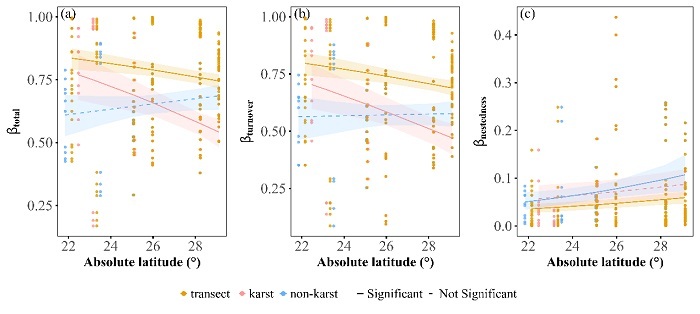
Latitudinal variations of β diversity in karst, non-karst and the entire transect, respectively(Imaged by Li Huang)
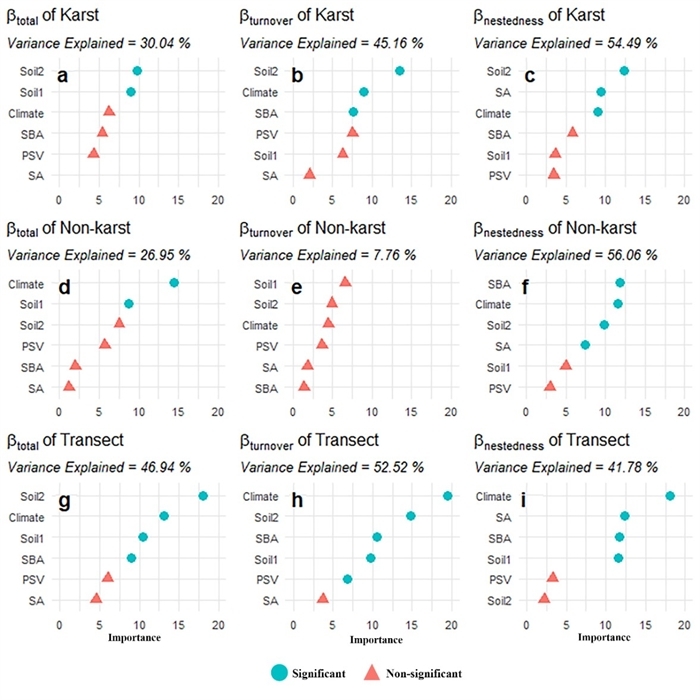
Effects of climatic factors, lithology-driven soil physiochemical properties and forest community structure on the variations of β diversity(Imaged by Li Huang)
