

Research Progress
Researchers Develop Novel Straw Granulation Technology for Rapid Soil Carbon Sequestration in Infertile Agricultural Soils
Improving soil organic carbon (SOC) levels is fundamental to enhancing cultivated land quality. While straw return has long been practiced as a common soil amendment strategy, conventional methods have shown limited efficiency in SOC accumulation. The conversion of straw into compact rod-shaped granules through crushing and compression enables high-intensity one-time straw input, yet its effects on SOC accumulation and underlying mechanisms remain poorly understood. Furthermore, due to the high C/nutrient ratio of straw, high-intensity granulated straw application may induce elemental imbalances (carbon excess with nutrient limitation). Whether supplementary nutrient inputs could alleviate microbial nutrient limitation, enhance microbial anabolism, and consequently improve straw carbon accumulation remains an open question.
The findings were published in Journal of Integrative Agriculture and Soil Ecology Letters.
Based on microcosm experiments conducted in typical newly reclaimed upland soils and infertile paddy soils in subtropical regions, scientists systematically investigated the effects of granulated straw application at varying intensities (0, 30, 60, and 90 t/ha) and nutrient supplementation regimes (C/N ratios of 40 and 25) on SOC accumulation and underlying mechanisms.
The results revealed distinct carbon conversion patterns between soil types. After one year of granulated straw application, the efficiency of straw carbon conversion to SOC in upland soils remained relatively stable across increasing application intensities (ranging from 30.8% to 37.5%). In contrast, paddy soils showed a decline from 60.0% to 38.3% with increasing straw input. The increase in SOC content under high-intensity straw application in both soil types was primarily attributed to plant residue accumulation rather than microbial necromass. This is explained by the physical spatial isolation effect of straw granules, which limits microbial access to and utilization of carbon sources within the granule interior, thereby enhancing straw carbon accumulation in the form of plant residues.
Under 30, 60, and 90 t/ha granulated straw applications, maize yields in upland soils increased by 25.0%, 55.6%, and 83.3%, respectively, compared to controls. In paddy soils, upland rice yields increased by 46.4%, 55.4%, and 64.3%, respectively.
Regarding nutrient supplementation effects, compared to pure granulated straw application, nutrient supplementation slightly reduced SOC content in upland soils but modestly increased SOC content in paddy soils. This was primarily attributed to nutrient supplementation enhancing microbial necromass carbon and mineral-associated organic carbon content. Importantly, straw granulation combined with nutrient supplementation further boosted crop yields, with maize and upland rice yields increasing by an additional 50.0% and 19.2%, respectively, compared to granulated straw alone.
"This study demonstrates that under high temperature and humidity conditions typical of subtropical regions, granulated straw application reduces microbial access to and decomposition of straw carbon, thereby improving annual straw carbon accumulation efficiency," said Prof. CHEN Xiangbi, corresponding author of the study. "This approach represents a rapid soil improvement pathway that simultaneously achieves soil carbon sequestration and crop yield enhancement in infertile agricultural soils, providing important scientific guidance for regional cultivated land quality improvement."
Contacted: CHEN Xiangbi
E-mail:xnchen@isa.ac.cn
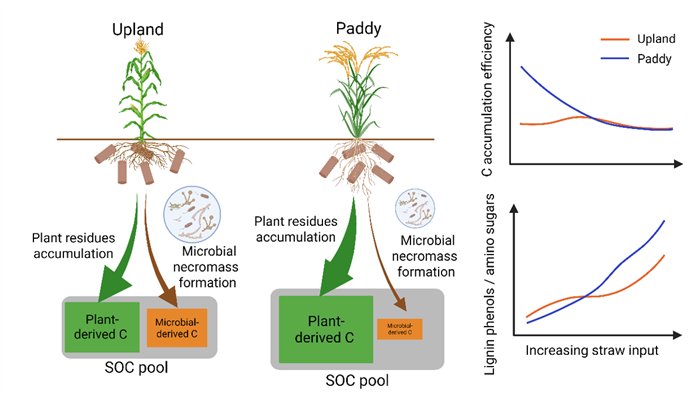
Figure 1 Response and mechanisms of soil organic carbon accumulation efficiency to granulated straw application intensity in infertile paddy and upland soils (Image by WANG Jun)
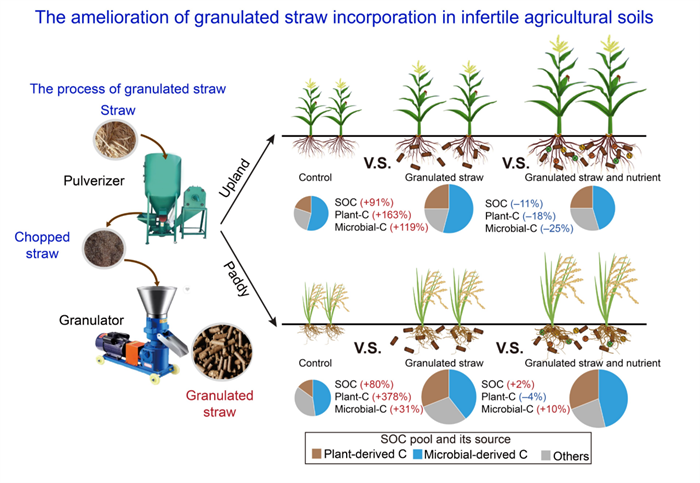
Figure 2 Effects and mechanisms of nutrient supplementation with granulated straw on soil organic carbon in infertile paddy and upland soils (Image by DUAN Xun)
