

Research Progress
Researchers Reveal Distinct Soil Carbon Sequestration Patterns and Saturation Levels Across Climate Zones in Eastern China
The capacity of agricultural soils to store organic carbon and the point at which they become saturated remain critical unknowns in global carbon cycle. Understanding both the current saturation levels and future sequestration potential of soil organic carbon (SOC) is essential for developing targeted strategies to enlarge the soil carbon pool and mitigate climate change—yet how climate and land-use practices jointly shape these parameters across large geographic scales has remained poorly understood.
A recent study led by Prof. CHEN Xiangbi's team at the Institute of Subtropical Agriculture, Chinese Academy of Sciences, has quantified the saturation levels and sequestration potential of mineral-associated organic carbon in agricultural soils across eastern China’s major grain-producing regions.
The work was published in Soil and Tillage Research on March 2026.
Based on 720 topsoil samples collected from adjacent woodlands, upland croplands, and paddy fields across four climate zones (mid-temperate, warm temperate, subtropics, and tropics) in eastern China, scientists comprehensively analyzed the distribution patterns of particulate organic carbon (POC) and mineral-associated organic carbon (MAOC), and assessed the saturation levels and sequestration potential of stable MAOC pools.
The results showed that total SOC content was generally lower in warmer climates (subtropics and tropics) than in cooler ones (mid- and warm temperate), with a consistent order across all climate zones: paddy fields > woodlands > upland croplands. MAOC dominated all soil organic carbon pools (60%-77%), but its contribution to total SOC was lower in warmer climates (58%) compared to cooler regions (69%).
Agricultural land-use practices fundamentally reshaped SOC composition and stability: compared with adjacent woodlands, paddy soils contained larger POC and MAOC pools but exhibited lower SOC stability (lower MAOC/POC ratios), whereas upland croplands had smaller carbon pools yet demonstrated higher stability (higher MAOC/POC ratios).
Notably, regardless of climate and land-use type, MAOC accumulation in all ecosystems has not yet reached saturation, as assessed by 95th quantile regression between the clay+silt fraction and current MAOC content. Although the average MAOC saturation degree exceeded 60%, its wide variation within and between individual soils suggests substantial additional carbon sequestration potential.
“China’s major grain-producing areas span a vast climatic gradient, yet we have long lacked systematic understanding of how climate and agricultural land-use practices jointly shape soil carbon pools,” said Prof. CHEN Xiangbi, corresponding author of the study. “Our findings underscore that SOC management strategies must be tailored to local land-use and climate conditions—considering not only how much carbon soils currently hold, but also how close they are to saturation and how much more they can potentially store as stable mineral-associated fractions.”
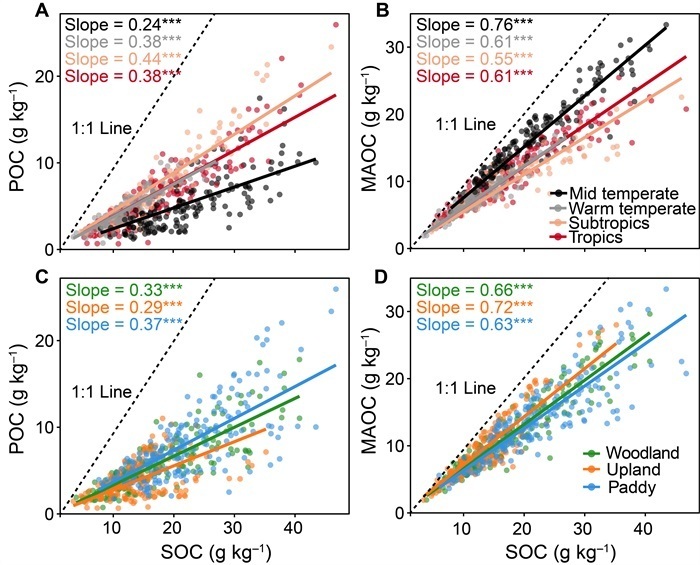
Figure 1 Content of particulate and mineral associated organic C in relation to soil organic C content for each climate zone and land-use type (Image by DUAN Xun)
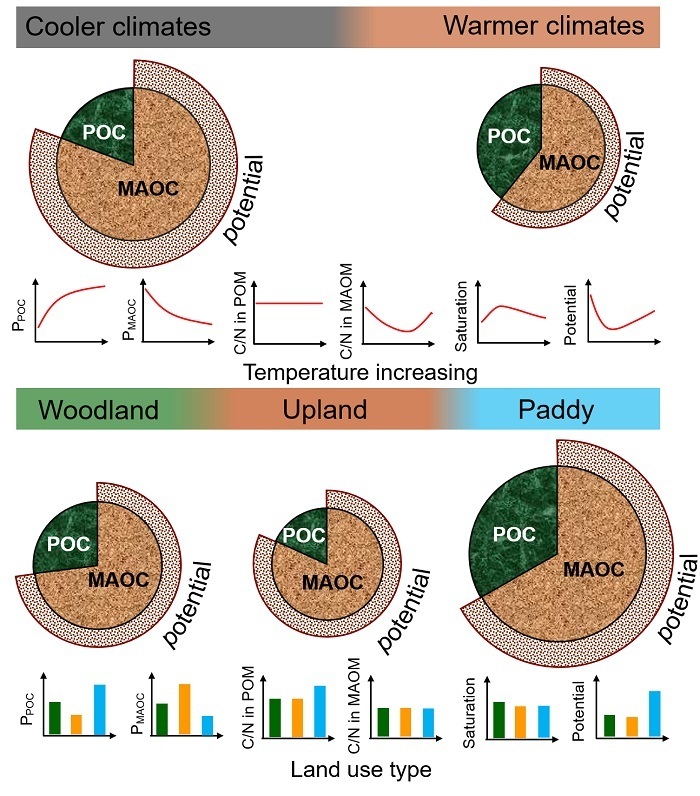
Figure 2 Schematic illustration of the effects of climate and land-use types on soil organic C fractions and mineral-associated organic C sequestration potential (Image by DUAN Xun)
