

Research Progress
Rewiring the Rumen Hydrogen Economy: A New Strategy for Methane Mitigation and Sustainable Livestock Production
In a study published in The Innovation on August 6, a research team led by Prof. TAN Zhiliang from the Institute of Subtropical Agriculture, Chinese Academy of Sciences, has now advanced a new conceptual framework that shifts the focus from methane reduction alone toward optimizing hydrogen utilization within the rumen ecosystem.
Methane emissions from cattle and sheep represent a major challenge for sustainable livestock production, contributing to global greenhouse gas emissions while also reflecting a loss of dietary energy that could otherwise support animal growth and productivity. Despite decades of research aimed at reducing methane emissions, most existing approaches have focused primarily on suppressing methanogenesis.
Their study establishes the concept of the “rumen hydrogen economy” as a new framework for understanding how microbial communities regulate energy flows in ruminants. This perspective redefines hydrogen metabolism as a central ecological process connecting microbial fermentation, electron transfer, methane production, and host energy acquisition.
The newly established framework proposes that methane emissions are not simply determined by the abundance of methanogens, but reflect the overall balance of microbial hydrogen production, transfer, and utilization. By viewing the rumen as an interconnected hydrogen-flow network, this work provides a new ecological interpretation of methane formation and identifies opportunities to redirect reducing power toward more energetically favorable pathways.
“Rather than treating methane as the only endpoint of rumen hydrogen metabolism, future mitigation strategies should focus on optimizing hydrogen allocation across microbial pathways,” Prof. WANG Min, the corresponding author explained. “This shift may enable simultaneous reductions in methane emissions and improvements in energy-use efficiency.”
Based on this framework, future research and intervention strategies could target multiple levels of rumen regulation, including controlling hydrogen generation from microbial fermentation, reshaping microbial interactions involved in hydrogen transfer, and enhancing alternative electron sinks that convert reducing equivalents into beneficial metabolites. Integration of microbiome engineering, precision nutrition, and emerging computational technologies may further enable dynamic regulation of rumen metabolic networks.
The establishment of the “rumen hydrogen economy” framework provides a new perspective for addressing the dual challenges of climate change mitigation and sustainable livestock production. By moving beyond methane suppression toward systematic regulation of microbial electron flows, this work highlights hydrogen metabolism as a potential cornerstone for developing low-emission and high-efficiency ruminant production systems.
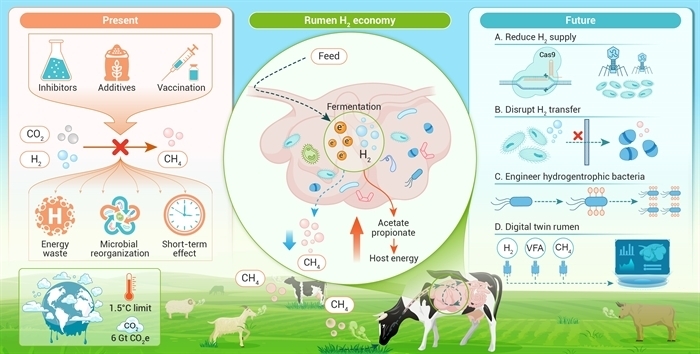
Conceptual framework of reprogramming the rumen hydrogen economy for enteric methane mitigation. e-, electron; CH4, methane; VFA, volatile fatty acid (Imaged by LI Qiushuang)
Contacted: WANG Min
E-mail: mwang@isa.ac.cn
