

Research Progress
Development and mechanistic insights into a hydrophobic rumen-targeted methane inhibitor, 1,3-PDN
Researchers led by Prof. Wang Min at the Institute of Subtropical Agriculture, Chinese Academy of Sciences, have revealed the mechanism of 1,3-propanediol dinitrate (1,3-PDN), a hydrophobic, rumen-targeted methane (CH4) inhibitor. The findings were recently published in The ISME Journal recently.
Ruminant livestock production, a major anthropogenic source of CH4 emissions, has become a central focus in global climate mitigation and sustainable agricultural development. In this study, the researchers designed and synthesized a hydrophobic small-molecule compound, 1,3-PDN, based on the structural framework of the hydrophilic CH4 inhibitor 3-nitrooxypropanol (3-NOP).
The study showed that hydrophobic properties of 1,3-PDN promote its accumulation within methanogenic archaeal cells (Figure 1), potentially increasing its accessibility to intracellular targets. Further investigations demonstrated that 1,3-PDN significantly reduced CH4 production in an in-vitro rumen fermentation system (Figure 2). 1,3-PDN primarily inhibits methanogenesis by suppressing the metabolic activity of hydrogenotrophic methanogenic archaea. Through molecular docking and proteomic analyses, the researchers found that 1,3-PDN interfere with the terminal methanogenesis reaction catalyzed by methyl-coenzyme M reductase and also affecting multiple redox-related processes involved in methanogenesis, thereby inhibiting CH4 production.
“This work builds on the membrane characteristics of methanogenic archaea and confirms that modulating the physicochemical properties of inhibitor can enhance its intracellular effective concentrations and target accessibility. These findings provide a new theoretical foundation for development of next-generation rumen-targeted CH4 inhibitors and offer a novel approach for promoting the low-carbon transformation of the global livestock industry” Prof. Wang Min, the co-corresponding author emphasized.
Contacted: WANG Min, ZHANG Xiumin
E-mail: mwang@isa.ac.cn, xmzhang@isa.ac.cn
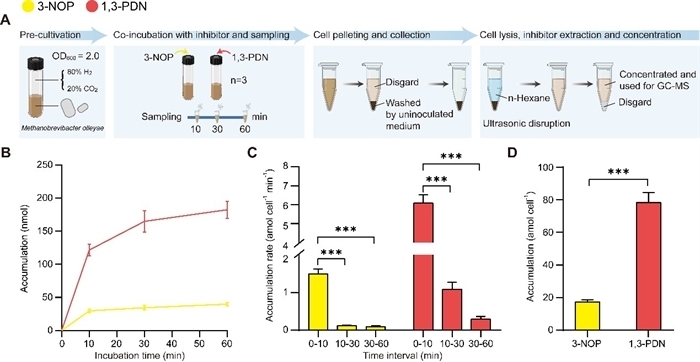
Figure 1. Intracellular accumulation of 1,3-PDN or 3-NOP in the Methanobrevibacter olleyae from the rumen of Hu sheep (Imaged by OUYANG Bingzi)
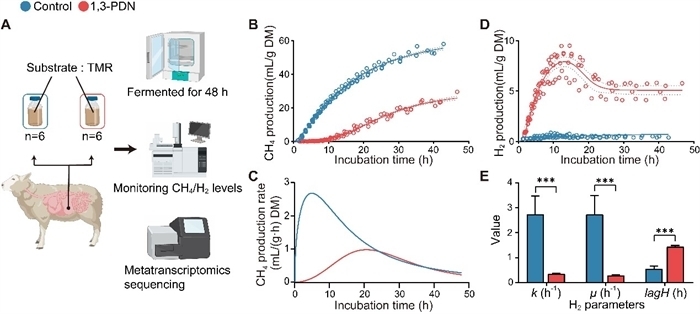
Figure 2. Effect of 1,3-PDN on the kinetics of methane (CH4) and hydrogen (H2) production through 48 h of ruminal batch culture (Imaged by OUYANG Bingzi)
