

Research Progress
Lithology and Climate Warming Regulate Soil Nutrients via Microbial Interactions, Study Finds
Bedrock geochemical properties govern soil mineral composition and nutrient availability, thereby regulating microbial community structure and function will ultimately influence soil carbon (C) and nitrogen (N) accumulation. However, how bedrock-derived geochemistry regulates nutrient accumulation under warming remains unclear, especially through its indirect effects on microbial interactions mediated by soil exchangeable calcium. To address this knowledge gap, a research team led by Prof. WANG Kelin from the Institute of Subtropical Agriculture of the Chinese Academy of Sciences conducted extensive field investigations across southwest China.
Their latest findings provide new insights into ecosystem sustainable in karst regions and were published in Global Change Biology and Communications Earth & Environment, respectively.
From the perspectives of lithological differences, researchers compared forest ecosystems developed on limestone and clastic rocks to systematically investigate free-living nitrogen fixation rates in soil and litter, as well as their relationships with microbial interaction networks. Furthermore, under warming conditions, they identified microbial regulatory pathways that drive C and N accumulation in calcium-rich soils of karst ecosystems.
The results shows that the higher pH and exchangeable calcium in limestone soils than in clastic rock soils significantly enhanced the abundance of diazotrophs and phoD-harboring bacteria. These changes enhanced the cooperative interactions among diazotrophs, phoD-harboring bacteria, and arbuscular mycorrhizal fungi, leading to more stable and complex microbial networks and ultimately higher nitrogen fixation rates.
Furthermore, warming increased C and N stocks in karst plantation forests, whereas soil organic carbon declined in croplands. These contrasting responses were associated with higher exchangeable calcium, greater microbial necromass accumulation, and stronger calcium–microbial and multi-trophic interactions in plantation soils.
The mechanisms by which calcium-rich soils enhance C and N accumulation can be summarized in two aspects. For one hand, elevated soil exchangeable calcium promotes microbial growth and metabolism, enhancing the formation and stabilization of microbial residues. For another hand, calcium strengthens both microbial and cross-trophic interactions, leading to more stable and tightly connected micro-food webs that facilitate coupled C and N accumulation under warming conditions.
Based on large-scale field sampling, this study reveals how calcium regulates soil C and N accumulation by promoting microbial growth and interspecific interactions, and proposes a “calcium–microbe–micro-food web” framework to explain the mechanisms driving C and N accumulation in karst ecosystems under global climate change.
Contact: WANG Kelin
E-mail: kelin@isa.ac.cn
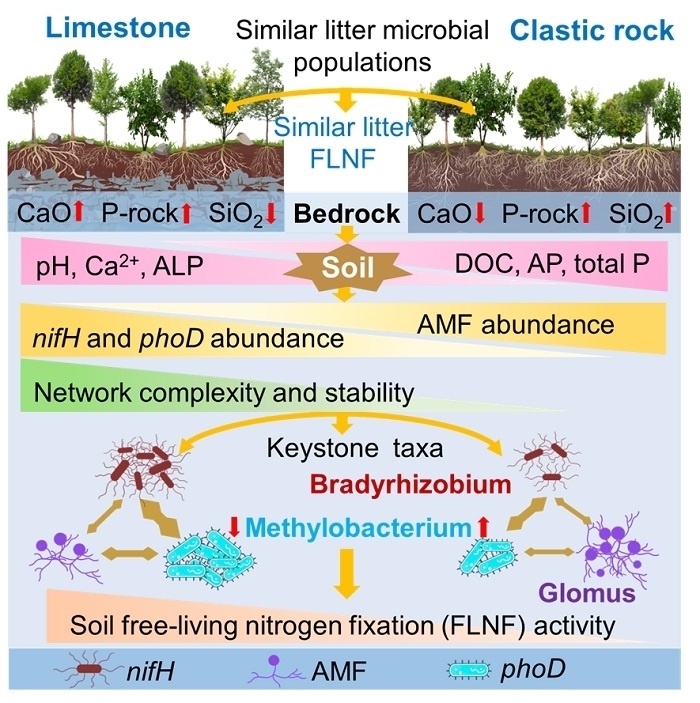
Microbial mechanisms driving free-living nitrogen fixation rates in soil and litter of karst and non-karst forests (Imaged by XIAO dan)
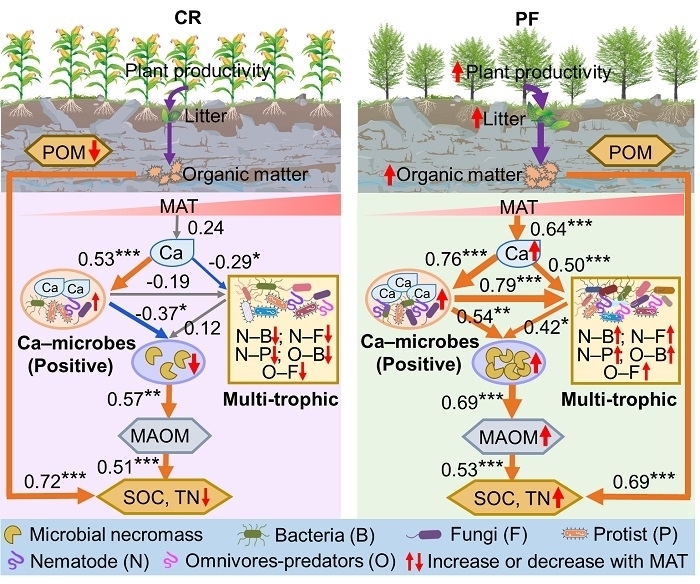
Mechanistic responses of soil carbon and nitrogen accumulation to warming in karst plantation forests and croplands.(Imaged by XIAO dan)
