

Research Progress
Synthetic Microbial Communities Significantly Enhance Humus Synthesis and Biosafety in Composting
In modern agricultural waste treatment, efficiently increasing the humus content of organic fertilizers and completely eliminating biological risks, such as antibiotic resistance genes (ARGs), are the key bottlenecks faced by the industry.
A research team led by Prof. LI Dejun from the Institute of Subtropical Agriculture of the Chinese Academy of Sciences uses synthetic microbial communities (SynCom) to drive the efficient humification of organic waste and block the transmission of biological hazards.
In their two latest published studies, inoculation with synthetic microbial communities consisting of five bacterial and fungal strains (including Bacillus cereus, Achromobacter sp., Pseudomonas sp., Cladosporium sp., and Trichoderma harzianum) has been proven to be effective accelerate the co-composting process of cattle manure and mulberry branches while ensuring product safety.
Regarding humus synthesis, SynCom inoculation significantly increased the pile temperature and shortened the maturation period. Data indicates that the overall degradation rates of lignin, cellulose, and hemicellulose increased by 19.3%, 7.9%, and 12.0%, respectively, and the humus content increased by 34.4%. Multi-omics analysis reveals that SynCom profoundly reshaped the indigenous microbial networks, enriched key functional genera (such as Thermobifida and Actinomadura), and significantly increased the abundance of key carbohydrate-active enzymes (CAZymes).
Concurrently, key humification precursors such as protocatechuic acid and sinapic acid were significantly enriched, providing abundant substrate support for subsequent humus polycondensation reactions.
In terms of enhancing biosafety, SynCom drove a key metabolic restructuring of the composting microbial community, prompting a shift from a biofilm-dependent defense mode to an active motility metabolic mode. This metabolic shift physically restricts opportunities for horizontal gene transfer.
Furthermore, the rapid decrease in the carbon-to-nitrogen ratio and the enhanced humification driven by SynCom effectively alleviated the co-selection pressure on metal resistance genes. Additionally, the structural collapse of high-risk interaction networks (with potential host-gene associations reduced by 26.6%) effectively severed the connections between ARGs and mobile genetic elements, and synchronously eliminated high-risk pathogens such as Pseudomonas aeruginosa.
These findings reveal the multi-level mechanisms of SynCom in improving the resource utilization efficiency of biowaste and ensuring the biosafety of organic fertilizers, providing an important methodological foundation and technical support for the application of microbiome engineering in sustainable agriculture.
Contacted:LI Dejun
EMail: dejunli@isa.ac.cn
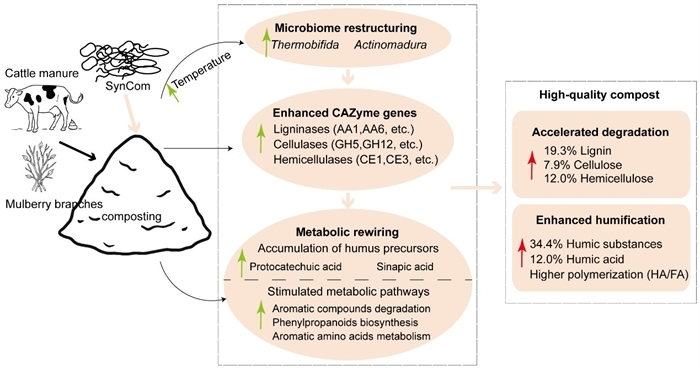
Mechanisms of synthetic microbial community inoculation in enhancing humus synthesis (Imaged by CHEN Shuangshuang)
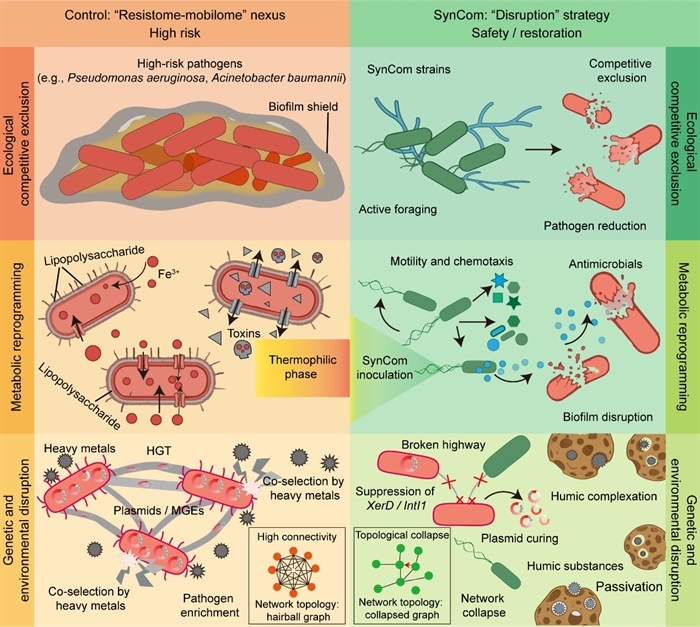
Mechanisms of synthetic microbial community inoculation in enhancing biosafety (Imaged by CHEN Shuangshuang)
