

Research Progress
Microbial Necromass Dominates Organic Carbon Accumulation in Calcareous Soil Following Afforestation, New Research
Serving as a fundamental driver of the global carbon cycle and climate feedback systems, the dynamics of soil organic carbon (SOC) are critical for climate stabilization. Although afforestation is widely recognized as a premier nature-based climate solution to enhance soil organic carbon sequestration, substantial uncertainties persist. Specifically, it remains unclear how the temporal dynamics of soil lignin and microbial necromass carbon (MNC) respond to afforestation. Furthermore, there is a lack of comprehensive knowledge regarding how these distinct carbon sources specifically drive the accumulation of particulate organic carbon (POC) and mineral-associated organic carbon (MAOC) in afforested environments.
To fill these gaps, researchers led by Prof. Li Dejun from the Institute of Subtropical Agriculture, Chinese Academy of Sciences, selected 14 pairs of maize fields and adjacent plantation forests in a karst region of southwest China, where soils are predominantly calcareous, and revealed that MNC exhibited a greater increment than soil lignin and dominated both soil POC and MAOC accumulation upon afforestation.
The results demonstrate that converting maize fields to afforestation markedly enhances SOC sequestration, leading to 265% and 136% expansions in the POC and MAOC pools, respectively. Following this land-use transition, the accumulation of MNC substantially outpaced that of lignin; MNC increased by 224% in the POC fraction and 96% in the MAOC fraction, compared to lignin increments of 100% and 66%, respectively. Structural equation modeling (SEM) elucidated three synergistic mechanisms driving post-afforestation carbon storage: (1) greater lignin retention via elevated plant litter inputs and suppressed lignin oxidation; (2) increased MNC accumulation fueled by higher microbial biomass; and (3) reinforced calcium-mediated mineral protection. Nevertheless, converging lines of evidence confirm that MNC, rather than lignin, acts as the principal driver governing the accumulation of both POC and MAOC in these afforested soils.
By focusing on calcareous soils within karst landscapes, this research advances the conventional dual-pathway framework for SOC formation. It posits that MNC functions as a shared precursor for both the labile (POC) and persistent (MAOC) carbon pools, thereby driving their coupled accumulation following the transition from cropland to forest. Consequently, these insights underscore the critical need to incorporate microbial-mediated pathways for carbon sequestration into Earth systems models, which will significantly enhance the predictive accuracy of SOC dynamics amid global environmental changes. This research, spearheaded by postdoctoral fellow Zihong Zhu as the first author, was published in the Journal of Applied Ecology under the title "Microbial necromass dominates particulate and mineral-associated organic carbon accumulation in calcareous soil following afforestation."
Contacted: Li Dejun
E-mail: dejunli@isa.ac.cn
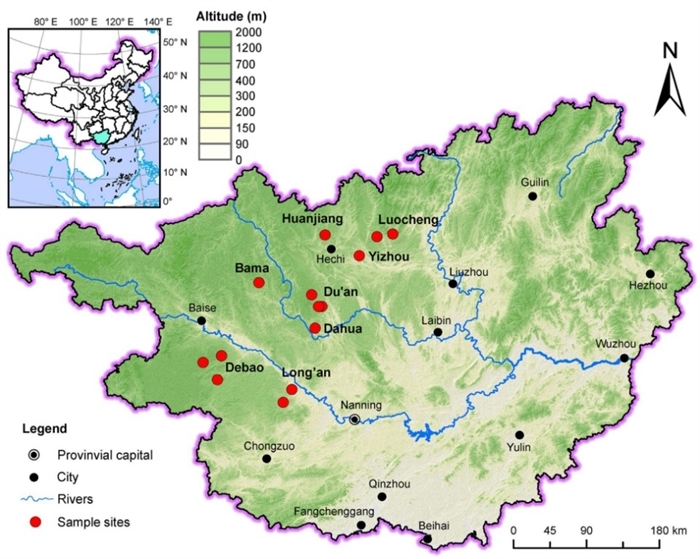
Schematic map describing the spatial distribution of 14 sample sites in the study region(Imaged by Zhu Zihong)
