

Research Progress
Researcher Identifies Key Determinants of Pork Quality
A recent study published in Food Research International conducted a systematic meta-analysis to clarify how genetic, regional, slaughter-related, and nutritional factors shape pork quality. These findings support pork-quality improvement through coordinated breeding, region-adapted management, optimized slaughter decisions, and precision nutrition.
The study was carried out by a team led by Prof. KONG Xiangfeng from the Institute of Subtropical Agriculture (ISA) of Chinese Academy of Sciences (CAS).
Pork quality links eating experience with product value, yet traits such as tenderness, water-holding capacity, intramuscular fat, fatty acid profile, marbling, and color are controlled by genetic, environmental, management, and dietary factors. Fragmented evidence makes production priorities difficult to rank.
By integrating data from 828 studies published between 2014 and 2024, the researchers analyzed 15 pork-quality traits, including pH, cooking loss, drip loss, shear force, intramuscular fat, flavor-related amino acids, fatty acid composition, marbling, and color. Breed, muscle position, geographic region, sex, slaughter age, slaughter weight, and dietary nutrient composition were evaluated using multi-level meta-analysis and meta-regression models.
The results showed that breed was a leading source of variation in pork quality, especially for intramuscular fat and other compositional traits. Native breeds such as Laiwu and Iberian pigs showed advantages in flavor- and fat-related traits, while commercial lines such as Duroc, Landrace, Yorkshire, and their crosses showed relatively stable physicochemical properties for large-scale production. These findings suggest that breed selection should be matched with product type, regional preference, and quality target rather than pursuing a single "best" genotype.
Geographic region also strongly affected water-holding capacity and color-related traits. Climate, altitude, local feed resources, rearing systems, and pre-slaughter handling may jointly regulate post-mortem muscle metabolism, moisture loss, tenderness, and meat appearance. The study therefore highlights the importance of region-specific management, such as heat-stress mitigation in hot and humid areas and adapted pre-slaughter protocols in high-altitude regions.
Production and dietary variables acted as trait-specific modifiers. Higher slaughter weight was associated with increases in flavor-related indicators, including intramuscular fat, oleic acid, and glutamic acid but may reduce tenderness. Nutritional effects were often non-linear: mineral balance, protein level, amino acid supply, and energy density were linked with water retention, lipid deposition, fatty acid composition, and color. These patterns support precision feeding for targeted pork-quality outcomes.
"By ranking these factors in one framework, we can better match breed resources, regional management and feeding strategies with different pork-quality goals," HU Weidong, the first author emphasied.
Contacted: KONG Xiangfeng
E-mail: nnkxf@isa.ac.cn
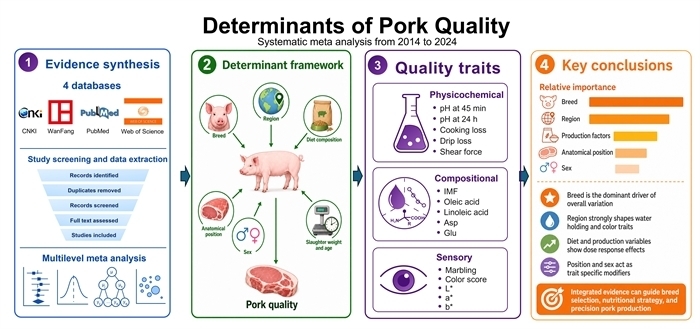
Figure 1. Graphical summary of evidence synthesis, determinant framework, quality traits, and key conclusions for pork quality regulation. (Image by HU Weidong)
