

Research Progress
New Strategy for Reducing Nitrogen Losses and Sustaining Tea Production in the Subtropics
A team led by Prof. SHEN Jianlin from the Institute of Subtropical Agriculture (ISA) Chinese Academy of Sciences (CAS), provides a new strategy for addressing nitrogen pollution in intensively managed tea plantations.
The research was published in Biochar on June 16. In this two-year field study, it has demonstrated that combining urease and nitrification inhibitors with biochar can significantly reduce nitrous oxide (N₂O) and ammonia (NH₃) emissions from tea soils while improving yields.
As a cash crop of high economic value, tea production needs a high rate of nitrogen fertilizer input. This overuse drives substantial gaseous nitrogen losses: N₂O is a potent greenhouse gas, while NH₃ contributes to fine particulate matter formation. Both pose threats to regional air quality and ecosystem health. Single inhibitors or biochar alone have shown limited success, often creating trade-offs between reducing one gas versus the other.
To fill these gaps, four treatments in a hilly tea plantation in Hunan Province were established : no nitrogen fertilizer, conventional fertilization, conventional fertilization with dual inhibitors (NBPT and DMPP), and conventional fertilization with dual inhibitors plus biochar at 28 tonnes per hectare. Over two consecutive growing seasons, gas emissions, soil nitrogen dynamics, and key microbial functional genes were tracked.
In the study, it revealed that under conventional fertilization, N₂O and NH₃ emission factors reached 3.0% and 8.1%, respectively, with gaseous losses concentrated in the fertilized tea rows—contributing 83.1% of N₂O and 68.4% of NH₃ emissions. Compared to conventional fertilization, the dual inhibitors alone cut N₂O and NH₃ emission factors by 54.5% and 20.0%. Adding biochar achieved similar overall reductions (49.8% for N₂O, 20.2% for NH₃), but with an important temporal dynamic: in the first year, biochar's adsorption properties slightly weakened inhibitor performance, whereas in the second year, as the biochar aged, its NH₃ mitigation efficiency surpassed that of inhibitors alone. This suggests that the synergy between biochar and inhibitors strengthens over time.
Mechanistically, the urease inhibitor NBPT slowed urea hydrolysis and reduced short-term soil ammonium concentrations by 45.7%, cutting the substrate for NH₃ volatilization. The nitrification inhibitor DMPP suppressed ammonia-oxidizing bacteria and nitrite reductase gene abundances by 39.4% and 19.0%, reducing soil nitrate production that fuels N₂O emissions.
Notably, the environmental benefits translated into productivity gains. The combined treatment increased tea yield by 6.7% and plant nitrogen uptake by 14.4%, yielding a net environmental economic benefit of 116,302 CNY per hectare per year—a 136.7% improvement over conventional fertilization.
"This combined inhibitor-biochar strategy can break the trade-off between reducing N₂O and NH₃ emissions, and its effectiveness improves with time in the two-year studing period." Prof. SHEN Jianlin, the corresponding author said". This offers a practical pathway for sustainable tea production in the subtropics."
Contact:SHEN Jianlin
Email: jlshen@isa.ac.cn
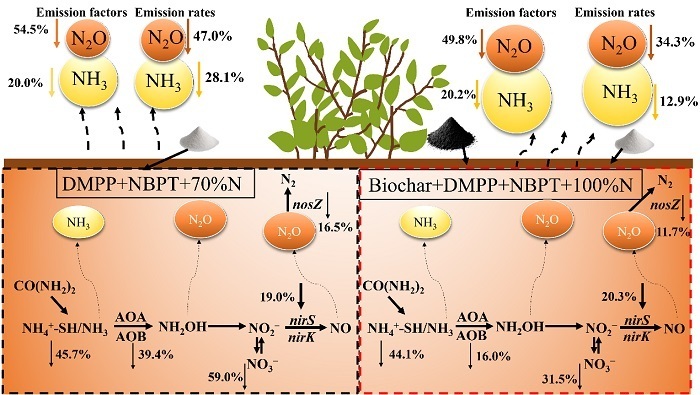
Effects and Mechanisms of Inhibitors and Combined Application of Inhibitors with Biochar on Mitigating N₂O and NH₃ Emissions(Imaged by LI Yuefeng)
