

Research Progress
Researchers Unlock a Novel Mechanism Underlying the Impacts on Lake Water Environments
Chlorophyll-a (Chl-a) in lakes is closely correlated with nitrogen (N) and phosphorus (P) nutrients. However, their dynamic coupling relationship and the characteristics of the eutrophication status lakes are unable to accurately be captured, due to the drastic fluctuations in hydrological regimes of river-connected lakes, high variabilities in nutrient transport and diffusion as well as phytoplankton growth in traditional research frameworks.
A recent study led by Prof. Xie Yonghong's team at the Institute of Subtropical Agriculture, Chinese Academy of Sciences, has uncovered that the universal Chl-a-nutrient model established based on global large-scale, long-term lake datasets are not applicable to river-connected lakes.
The findings were published in Ecological Indicators on September 2025.
Based on long-term hydrological and water environment monitoring data of Dongting Lake from 2004 to 2021, scientists comprehensively analyzed the dynamic response relationship between Chl-a and N-P nutrients across different hydrological seasons, and clarified the limiting effects and effect mechanisms of N-P nutrients and hydrological conditions on Chl-a variations.
The results showed that Dongting Lake is generally in a mesotrophic-eutrophic state, with the Trophic State Index (TSI) significantly higher in the flood season than in the dry season. Despite the high concentrations of N and P in the lake, Chl-a concentrations remain relatively low, indicating an asynchronous response pattern between Chl-a and N-P nutrients. Total nitrogen (TN) concentration of 1.29 mg/L was identified as the critical threshold determining the Chl-a trophic status during the wet season; besides, the dominant role of nitrogen limitation on Chl-a gradually intensifies from the flood season to the dry season. The Chl-a trophic status and nutrient limitation conditions are highly susceptible to hydrological regime changes. Hydrometeorological factors such as water level and water temperature, in conjunction with N-P nutrients, synergistically regulate Chl-a variations in the lake, with the intensity of their effects exhibiting distinct seasonal shift characteristics.
"River-connected lakes have long been overlooked in global lake hydrological research," Professor Feng Li, the corresponding author emphasized, "Characterized by drastic fluctuations in hydrological regimes, high sensitivity of water environments, and fragile lake ecosystems, these water bodies demand our focused attention on the measures for improving and upgrading their water environments. Such efforts will help enhance the lakes’self-purification capacity and ecological stability."
Contacted: Feng Li
E-mail: Lifeng@isa.ac.cn
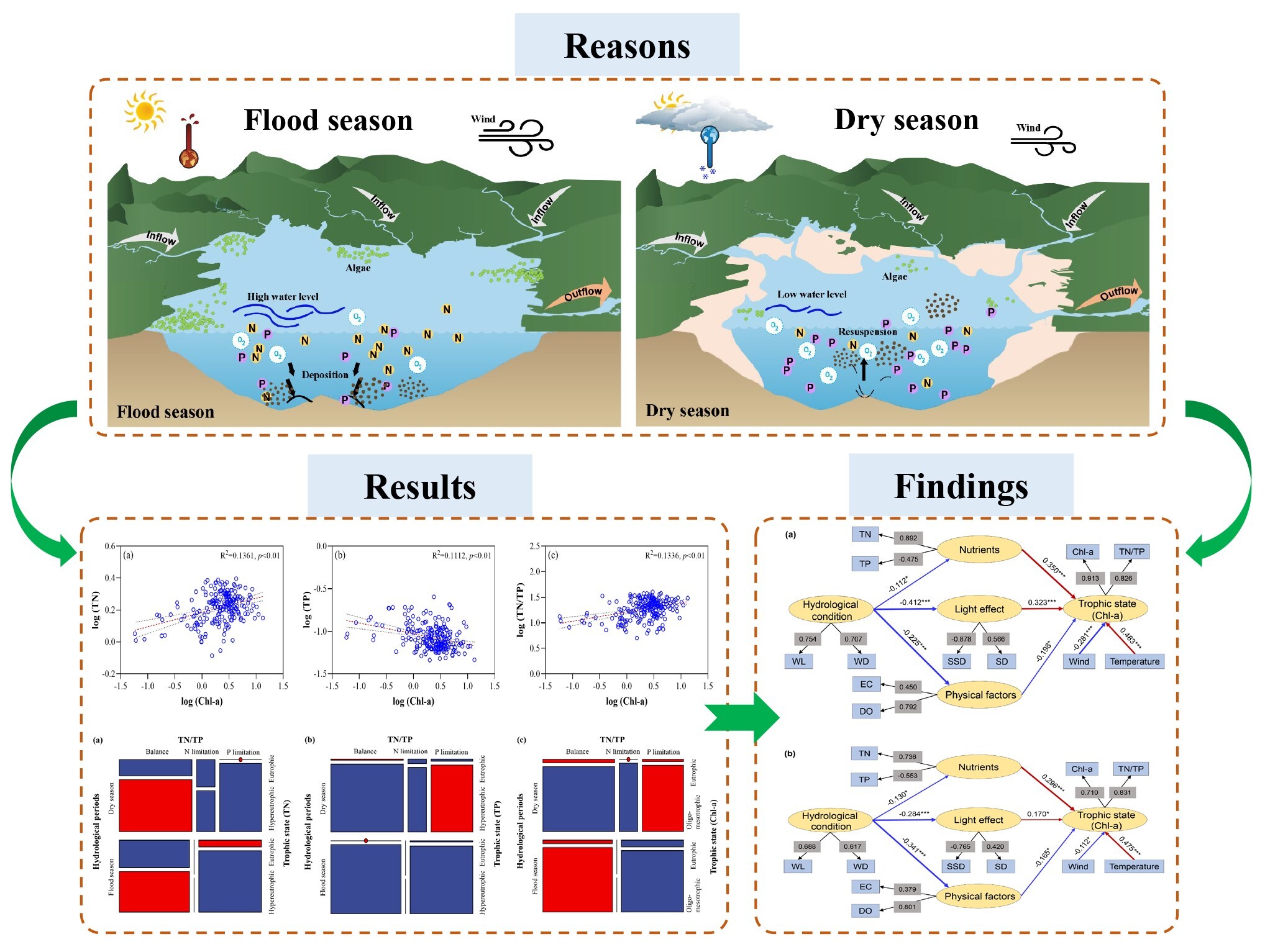
The relationship and effect mechanism between chlorophyll-a and N-P in Dongting Lake under different hydrological conditions.(Imaged by Mingming Geng)
